Dr. James A. Glazier
Professor, Department of Intelligent Systems, Engineering Director, Biocomplexity Institute, Indiana University, Bloomington
Tuesday | March 10th, 2026 | 2:00pm – 3:20pm | Skye 284
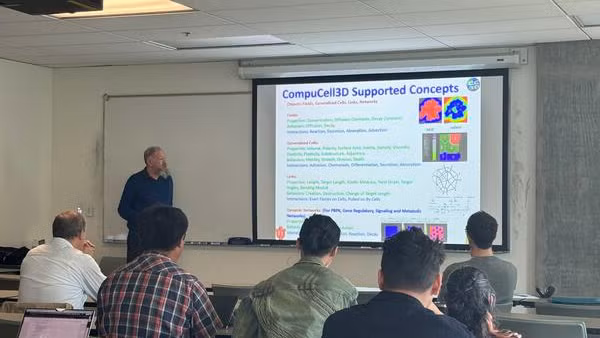
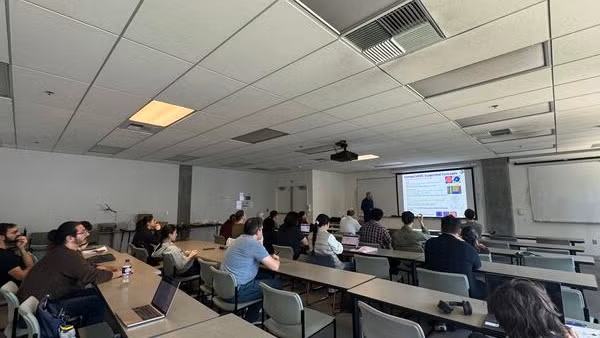
Abstract: Multi-scale, Multicellular Agent-Based Virtual-Tissue models are versatile tools for exploring how the complex interactions between cells and their local environment and between that environment of Development, Homeostasis and Diseaseand signaling and regulatory control lead to patterning during development, maintenance of tissues during homeostasis and recovery after injury and failure of tissue organization and function due to damage or disease. This talk explores the evolution and application of multiscale, multicellular agent-based "Virtual Tissues" using the CompuCell3D (CC3D) modeling environment. The CC3D project originated more than 25 years ago in a collaboration between Dr. Glazier, Dr. Mark Alber and others at the University of Notre Dame under an NSF Biocomplexity grant. I will talk a bit about the history of the methodology and its strengths and limitations and then illustrate its use in a variety of contexts new and old, from the simulation of somite formation during development to epithelial homeostasis, vascular invasion and kidney cystogenesis. I will highlight two recent applications of this approach. First, a computational model of neural tube closure defects, demonstrating how transcriptomics-driven perturbations can be mapped onto conserved pathways to enable probabilistic hazard assessment of developmental failure. Second, adult-tissue Virtual-Tissue toxicology models of the cornea (vCornea). I am particularly interested in suggestions for extensions and improvements around the core CPM formalism and for potential novel applications. You can download CompuCell3D from https://compucell3d.org/SrcBin
For a list of recent papers published using CompuCell3D see: https://compucell3d.org/Publications
Bio: James A. Glazier, PhD, is Professor of Intelligent Systems Engineering and a Director of the Biocomplexity Institute at Indiana University Bloomington. He develops physics-based, mechanistic multicellular “Virtual Tissue” simulations that link molecular and cellular perturbations to emergent tissue injury, repair, and disease phenotypes, with a growing emphasis on New Approach Methodologies (NAMs) and in vitro–to–in vivo extrapolation (IVIVE) for toxicology and drug discovery.
Glazier is a founder and long-term lead developer of CompuCell3D, an open-source, multiscale agent-based modeling environment that supports simulations of development, cancer, immune processes,and tissue repair. His work emphasizes enabling broad reuse of models through durable software infrastructure, documentation, and training, including an ongoing international workshop program on multiscale virtual-tissue modeling. Glazier also leads community efforts that connect mechanistic modeling to translational needs, including the GLIMPRINT-NIH IMAG/MSM Working Group on Multiscale Modeling and Viral Pandemics partnership, which encourages multiscale immune modeling, standards, validation, and model reuse, and OpenVT, an NSF-funded initiative to create a FAIR, interoperable ecosystem for virtual tissue models and to reproducible modeling practices.
Glazier is a Fellow of the American Association for the Advancement of Science, the American Physical Society and the Institute of Physics (London), and has served as Chair of the APS Division of Biological Physics.